Tuesday, August 7, 2012

Achieve Fitness by Swimming


U.S. Men's 2012 Olympic Swim Team 
The London 2012 Olympics got me thinking about different exercise programs for fitness. Swimming is an often overlooked fitness approach that has some benefits.

Swimming is an option for those who are injured with reduced exercise options. Here are some reasons to consider a swimming program for exercise.


1.  Swimming is probably the gentlest aerobic exercise available to you!  Unlike jogging, aerobic dancing, or even brisk walking, it doesn't damage your joints, bones, or feet.  If you are overweight, have joint problems, or have been injured, this is the perfect exercise for you.  It's great for people with arthritis as it improves the body's fitness without pressure, which could make some ailments worse.

2.  The water in the pool is a form of resistance, and as your body moves through the water, the resistance improves your muscle tone.  Your body becomes more flexible and your cardio fitness also improves.

3.  Take a class at your a local YMCA, gym, or health club.  Even public pools offer classes.  You may not need many lessons to relearn the proper way to do the different strokes, but having these lessons can make your swimming workout more effective.  Learn a variety of strokes so you can vary your workouts as your fitness increases.

4.  Find different places for your swimming workouts.  You can chose to go to a public pool, swim outdoors, go to the local YMCA, or a community center.  Maybe you have a friend who has their own pool!  Vary your routine so sometimes you are swimming indoors and other times you are swimming outdoors where you can enjoy nature.

5.  If you are extremely out of shape, learn strokes that are not as intense as others.  As you gain in fitness, you can add more strenuous strokes and vary your workout.

6.  As with any exercise program, be sure to check with your doctor before you begin.  Even if you have a health concern that precludes other exercise regimes, you might be able to begin swimming with the aid of a kickboard, paddles, or flippers.  This is also true if you have recently been injured and are still recovering.  There is no reason you cannot begin an exercise regime, with the consent of your doctor, to decrease the time it takes to recover and begin getting your body totally in shape.

-----
Article Word Count:  408

Sunday, August 5, 2012

High protein food sources

I'm a big fan of cooking light. The magazine has tons of recipes and articles that help and motivate me for healthy living and healthy eating.

I ran across an article on Cooking Light on daily protein needs to build muscle and share it here.

Wednesday, August 1, 2012

Easy-to-Follow Weight Training Program For Beginners


Are you ready to get into shape, or improve the shape you're already in?  This muscle and basic-strength weight training program may be just what you need.

As with any new exercise program, visit your healthcare professional first to see if there are any restrictions on what you can do.  Also, changing your eating habits to eat a healthy diet will go a long ways towards increasing your fitness and safeguarding your health.

Before you begin this formal program, remember that any plan works well if it's designed for your body and fitness goals.  Talk to a personal trainer at your health/fitness club to see what he/she advises.

You will be able to find the equipment and free weights you need at almost any health/fitness club.  If you prefer, and you have the equipment at home, you can do your workout there.

Remember, it's important to take your medical condition into consideration before beginning.  If you have injuries, joint damage, or have just had surgery, factor these conditions into your training routine.  As your fitness level improves, you can ramp your routines up a little bit at a time.

Here are the steps to follow.  For each of the nine exercises, do one set of twelve repetitions, gradually increasing the number of repetitions, so by week eight, you are up to three sets of twelve repetitions:

1.  Warm Up:  The best way to warm up is with aerobics.  This should only take ten minutes or so.

2.  Squats or Leg Presses:  If you're just beginning, leave the squats for later and use the machine leg press for starters.

3.  Chest or bench press.

4.  Dead Lift.

5.  Crunch.

6.  Seated cable row.

7.  Triceps push down.

8.  Lateral pull down.

9.  Over head press.

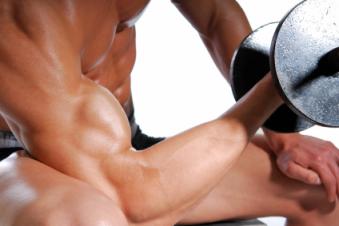
10.  Biceps curl.

11.  Cool down and stretch - Yoga stretches would be nice to incorporate into your cool down.

Pay attention to your form or have a friend or someone at the health club "spot" for you to make sure you are doing the exercises correctly for the maximum benefit.

Talk to the personal trainer at the health fitness club to determine how long you should rest between repetitions.  This will depend on what your fitness goals are.  Also, have him/her help you determine how heavy your beginning weight should be.  There are a lot of different formulas to help with this.